
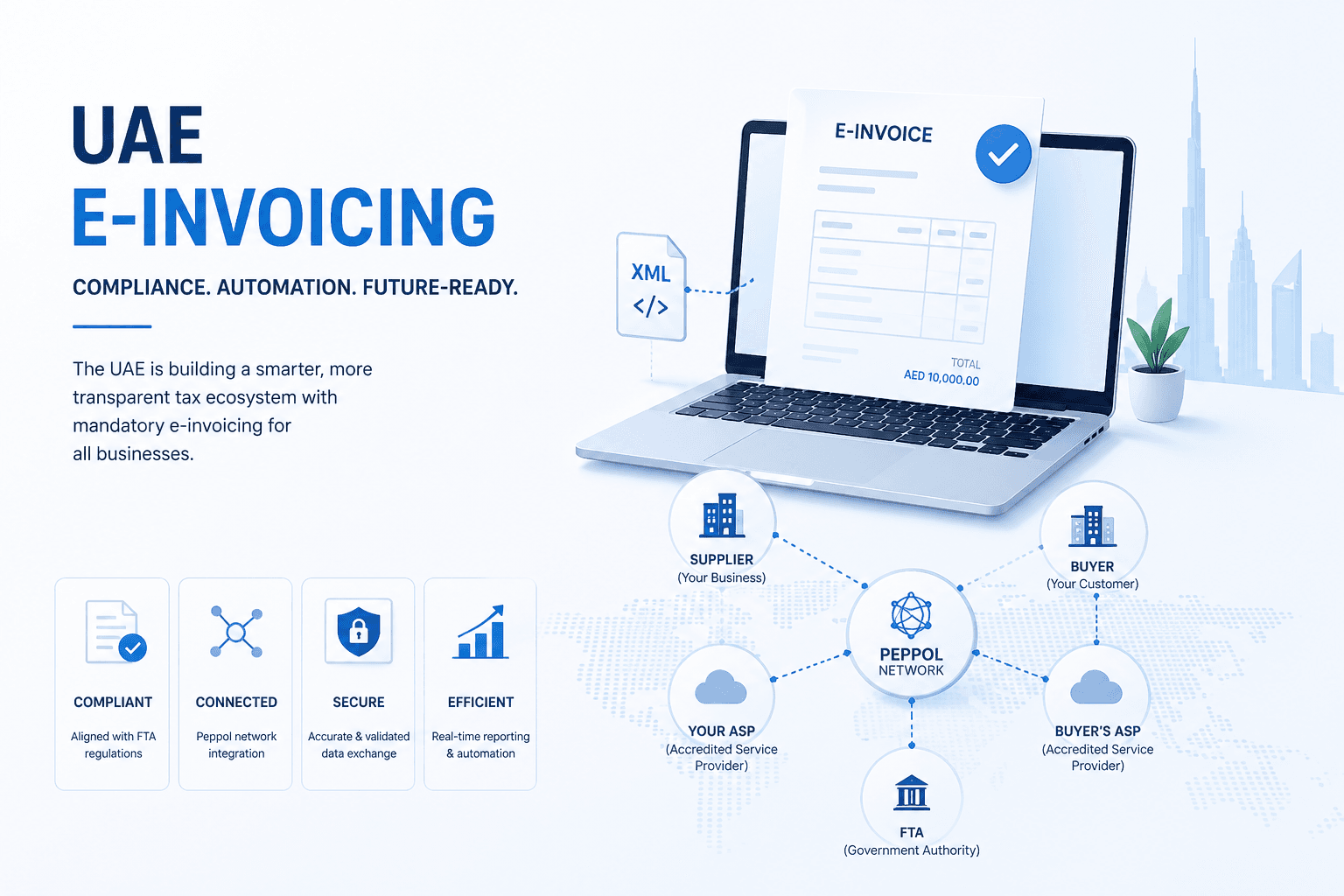
The UAE's mandatory e-invoicing system, a crucial digital tax reform, launches its pilot on July 1, 2026, with phased deadlines extending through 2027. This mandate replaces traditional PDF invoices for B2B and B2G transactions, requiring structured XML via the Peppol network. Prepare your business now to avoid significant AED 5,000 monthly penalties. BWMC provides expert consulting on the impact, deadlines, and essential compliance steps for UAE e-invoicing.
Introduction
On 29 September 2025, the UAE Ministry of Finance issued Ministerial Decisions 243 and 244 of 2025, establishing the legal framework and phased rollout schedule for the country’s Electronic Invoicing System (EIS) (UAE E-invoicing). The mandate was further reinforced by Cabinet Decision No. 106 of 2025, which set the penalty framework for non-compliance.
The system is built on the internationally recognised Peppol (Pan-European Public Procurement Online) network — the same standard used across Europe, Singapore, and Australia. All B2B (business-to-business) and B2G (business-to-government) invoices must be issued in structured XML format and transmitted through a Ministry-accredited service provider. Traditional PDF invoices are explicitly excluded.
Whether you are a large enterprise approaching the January 2027 deadline or an SME preparing for July 2027, one fact applies equally: ERP system changes, service provider onboarding, and staff training take months. Businesses that wait until the deadline will not have enough time. The cost of inaction is AED 5,000 per month in penalties — in addition to existing VAT and corporate tax penalty frameworks.
Legal Basis: Ministerial Decision No. 243 of 2025 (scope and technical standards) · Ministerial Decision No. 244 of 2025 (phased implementation timeline) · Cabinet Decision No. 106 of 2025 (penalty framework)
What Is UAE E-Invoicing and Why Is It Happening?
UAE e-invoicing is a government-mandated system requiring businesses to issue, transmit, and receive invoices in a structured digital format through a certified digital network. It replaces traditional paper and PDF invoicing for B2B and B2G transactions entirely.
The system serves three core government objectives:
Close the VAT gap — real-time visibility of all B2B transactions lets the FTA cross-check buyer and seller records automatically
Modernise tax administration — automated invoice validation reduces the need for manual audits and inspections
Support the UAE’s digital economy agenda — aligning with the UAE’s strategy to be among the world’s most advanced digital economies by 2031
A critical point many businesses have missed: the UAE e-invoicing guidelines (published February 2026) confirm that the mandate applies to all persons conducting business in the UAE—including Free Zone companies—regardless of VAT registration status.
The Phased Rollout: Deadlines You Cannot Miss
The UAE e-invoicing rollout operates in phases based on company revenue. Below is the full implementation timeline:
1 July 2026
Pilot Programme Launches
Voluntary adoption opens for selected pilot businesses. The FTA will notify pilot participants directly. Any business may opt in from this date.
31 July 2026 — URGENT
ASP Appointment Deadline — Revenue ≥ AED 50 Million
All businesses with annual revenue of AED 50 million or more must appoint a Ministry of Finance-accredited Service Provider by this date. Missing this deadline triggers the AED 5,000/month penalty immediately.
1 January 2027 — MANDATORY Phase 1
Go-Live for Revenue ≥ AED 50 Million
All B2B and B2G invoices must be issued as structured XML through an approved ASP. PDF invoices are legally invalid from this date for Phase 1 businesses.
31 March 2027
ASP Appointment Deadline — Revenue Below AED 50 Million
Smaller businesses and government entities must appoint their ASP by this date ahead of the July 2027 mandatory go-live.
1 July 2027 — MANDATORY Phase 2
Go-Live for All Remaining Businesses
Mandatory e-invoicing for all remaining businesses. Government entities follow on 1 October 2027.
Important: Selecting and onboarding an ASP, integrating with your ERP system, and testing invoice flows typically requires 3 to 6 months. If your revenue exceeds AED 50 million and you have not yet started ASP selection, you are already at risk of missing the July 31, 2026 deadline.
Critical: What Counts as a Valid UAE E-Invoice
PDF invoices are explicitly invalid
Under UAE e-invoicing regulations, a PDF invoice — even one sent by email, even one generated automatically by your accounting software — is not a valid e-invoice. This is the single most important fact for businesses to understand, as it requires a complete change in how invoices are created and transmitted.
A valid UAE e-invoice must be the following:
Created in structured XML format (PINT-AE or UBL standards)
Transmitted through a Ministry of Finance-accredited Service Provider (ASP)
Sent via the Peppol network using the UAE’s 5-corner model
Issued within 14 days of the taxable supply
Stored electronically within the UAE for the required retention period
What is excluded from the mandate
B2C transactions — business-to-consumer invoices are excluded until further notice
Government entities acting in a sovereign capacity, not in commercial competition
International passenger air transport where electronic tickets are issued
International air freight where an airway bill is issued (24-month transitional exclusion)
Certain VAT-exempt or zero-rated financial services
How the Peppol 5-Corner Model Works
The UAE e-invoicing system uses the Peppol network – an international standard also used across Europe, Singapore, and Australia. Here is how an invoice moves from your business to your buyer:
Supplier Creates the Invoice
Your ERP or accounting system generates a structured XML invoice complying with UAE standards (PINT-AE or UBL format).
Invoice Sent to Your ASP
Your Accredited Service Provider receives and validates the invoice, checking format, content, and compliance requirements before it proceeds.
ASP Routes via Peppol Network
Your ASP transmits the validated invoice across the Peppol network to your buyer’s ASP, ensuring interoperability between different providers.
Buyer’s ASP Delivers to Buyer
The buyer’s ASP delivers the verified, compliant invoice. Buyers can only receive invoices that have passed the full validation chain.
Data Reported to FTA in Real Time
Tax data from the transaction is simultaneously reported to the Federal Tax Authority, giving the FTA real-time visibility of all B2B and B2G transactions.
UAE E-Invoicing Penalties: The Full Framework
Cabinet Decision No. 106 of 2025 establishes the penalty framework. These penalties apply once a business is formally mandated to adopt e-invoicing after their phase deadline.
Violation Penalty Notes Failing to implement or appoint an ASP by the deadline: AED 5,000 / month Starts from day one after the deadline
Failing to transmit invoices via the approved system: AED 100 / invoice Capped at AED 5,000 per month
Failing to report system malfunctions to FTA within 2 business days: AED 1,000 / day Until proper notification and remediation
Issuing invoices in non-compliant format (e.g., PDF) Existing VAT penalty framework Treated as invalid tax invoice Failure to retain e-invoice records in compliant UAE storage Tax procedures penalties 5-year VAT; 7-year corporate tax retention
Important: E-invoicing fines are in addition to existing VAT and corporate tax penalties. A business facing e-invoicing non-compliance alongside VAT issues could face simultaneous, cumulative penalty streams from multiple frameworks.
Who Needs to Act Right Now
If your revenue exceeds AED 50 million
You are in Phase 1. Your ASP appointment deadline is 31 July 2026. Given that onboarding, ERP integration, and system testing require 3–6 months, you should already be in active ASP selection mode. Contact BWMC immediately for a readiness assessment.
If your revenue is below AED 50 million
Your mandatory deadline is July 2027. However, early action is strongly advisable. The 2026 period will see intense ASP onboarding activity from larger businesses, and provider capacity may tighten. Starting your readiness work now gives your team time to adapt without compliance pressure.
If you are registered in a UAE Free Zone
The mandate applies to you. Free Zone status does not exempt your business. If you conduct B2B or B2G transactions, your invoices must comply subject to the same phased deadlines.
If you are not currently VAT-registered
The mandate applies regardless of VAT registration status. You must register with the FTA to obtain your TIN and comply with e-invoicing requirements when your phase deadline arrives.
Your E-Invoicing Readiness Checklist
Use this checklist to assess where your business stands today:
Determine which phase applies based on annual revenue (AED 50M+ = Phase 1; below AED 50M = Phase 2)
Confirm your FTA Tax Identification Number (TIN) is active and up-to-date on EmaraTax
Assess whether your current invoicing or ERP software can generate structured XML in PINT-AE or UBL format
Research and shortlist Ministry of Finance-accredited ASPs suited to your sector and volume
Begin ASP selection and contract negotiation — allow 4 to 8 weeks minimum
Plan ERP or accounting system integration with your chosen ASP
Test invoice creation, transmission, and receipt in a sandbox environment before go-live
Update invoicing terms and buyer communications to reflect the new format
Brief your finance team on the new workflow and FTA reporting requirements
Confirm invoice storage meets UAE data residency and retention requirements (5 years VAT, 7 years corporate tax)
How BWMC Helps Your Business Comply
At BWMC, we specialise in navigating the UAE’s evolving tax and compliance landscape for businesses of all sizes. E-invoicing sits at the intersection of technology, tax law, and operational process — and getting it wrong has real financial consequences.
Our e-invoicing advisory services cover:
Readiness Assessment — we evaluate your current invoicing setup against the mandate’s full requirements and identify exactly what needs to change
ASP Selection Support — we help you identify and evaluate accredited service providers suited to your business volume, industry, and ERP environment
FTA Compliance Review — we verify your existing VAT and corporate tax records are clean before e-invoicing creates new FTA visibility into your transactions
Implementation Planning — we create a project timeline aligned to your compliance deadline and coordinate with your IT team or ERP vendor
Ongoing Compliance Support — monitoring, system malfunction reporting, and regulatory updates as the mandate evolves
As an FTA-approved, IFRS-certified consultancy, BWMC has guided hundreds of UAE businesses through the VAT transition in 2018 and the corporate tax rollout in 2023. E-invoicing is the next step — and our clients will be ready.
Frequently Asked Questions
These questions are answered in full compliance with current UAE regulations as of May 2026.
Q: When does UAE e-invoicing become mandatory?
UAE e-invoicing becomes mandatory in phases. The pilot programme launches July 1, 2026. Businesses with revenue of AED 50 million or more must comply by January 1, 2027 and must appoint an ASP by July 31, 2026. Businesses below AED 50 million must comply by July 1, 2027, with an ASP appointment deadline of March 31, 2027.
Q: Is a PDF invoice valid under the UAE e-invoicing mandate?
No. Under Ministerial Decision No. 243 of 2025, a PDF invoice is explicitly not valid regardless of delivery method. All invoices must be in structured XML format and transmitted through a Ministry of Finance-accredited ASP via the Peppol network.
Q: What are the penalties for not complying with UAE e-invoicing?
Under Cabinet Decision No. 106 of 2025: AED 5,000 per month for failing to implement the system or appoint an ASP; AED 100 per invoice (capped at AED 5,000/month) for failing to transmit through the approved system; AED 1,000 per day for failing to report system malfunctions to the FTA within two business days.
Q: What is an Accredited Service Provider (ASP)?
An Accredited Service Provider (ASP) is a Ministry of Finance-approved intermediary that validates and transmits e-invoices between suppliers, buyers, and the FTA via the Peppol network. Businesses must appoint an ASP before their compliance deadline — July 31, 2026 for large businesses or March 31, 2027 for smaller ones.
Q: Does UAE e-invoicing apply to B2C transactions?
No. As of 2026, B2C transactions are excluded from the mandate. It applies to B2B and B2G transactions only. The status of B2C transactions may be reviewed in future phases.
Q: Do Free Zone companies need to comply with e-invoicing?
Yes. UAE e-invoicing applies to all persons conducting business in the UAE, including Free Zone companies, regardless of VAT registration status. Exceptions are limited to specific sovereign government activities, international air transport, and certain exempt financial services.
Q: How long must e-invoices be stored in the UAE?
Electronic invoices must be stored within the UAE in a secure electronic system. The retention period is generally 5 years for VAT records and 7 years for corporate tax records. Storage must be accessible and retrievable by the FTA upon request.
Written By

Written by
Mahesh Thadani
Director
Mahesh Thadani is a seasoned Certified Chartered Accountant and senior finance professional with extensive expertise across taxation, financial advisory, and international business structuring. With a strong command over UAE regulatory frameworks—including VAT, Corporate Tax, ESR, AML, and KYC compliance—he advises businesses on navigating complex financial and legal landscapes with precision and strategic clarity.